
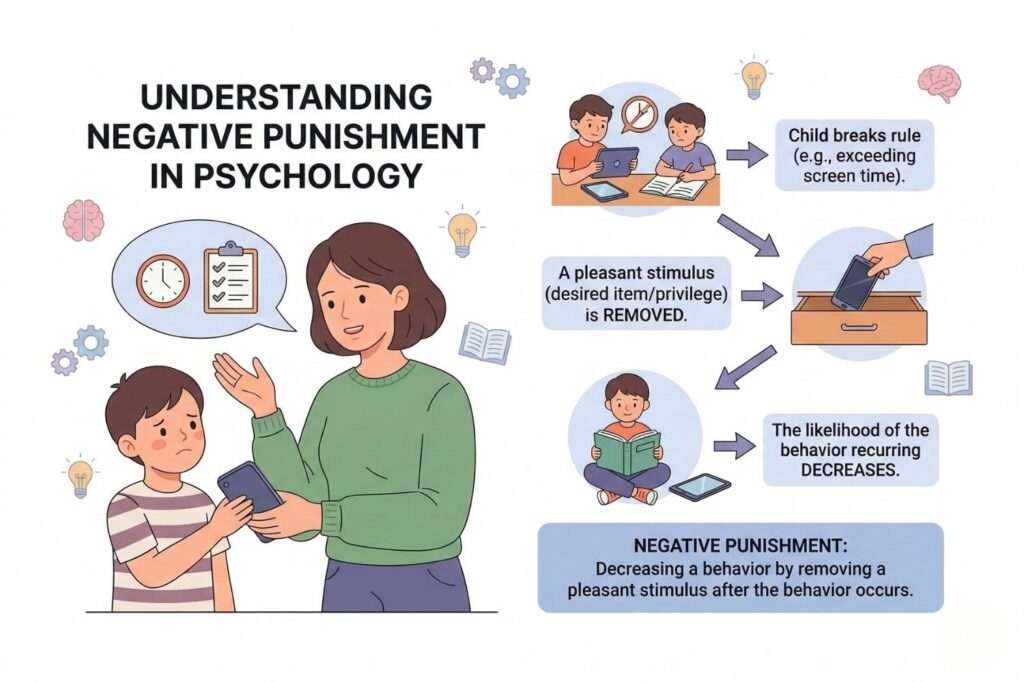
Human behavior is shaped by consequences. Every action we take often leads to either a reward or a loss, which influences whether we repeat that behavior again. One important concept that explains this process is negative punishment.
Many people misunderstand the term because of the word negative. In psychology, negative does not mean “bad.” Instead, it simply means removing something to change behavior.
In this guide, we will explore negative punishment examples, explain how the concept works in everyday life, and show how it influences behavior in parenting, education, workplaces, and relationships.
Understanding these examples can help you improve discipline strategies, strengthen relationships, and encourage positive habits.
What Is Negative Punishment in Psychology?
Negative punishment is a concept from behavioral psychology where something desirable is removed after an unwanted behavior occurs to reduce the chances of that behavior happening again.
The idea comes from operant conditioning, a theory developed by psychologist B.F. Skinner. Operant conditioning explains how behavior is influenced by rewards and consequences.
In simple words:
Negative punishment = Removing something pleasant to stop unwanted behavior.
For example:
- A child loses video game time after breaking a rule.
- A teenager loses phone privileges for missing curfew.
- An employee loses a bonus after poor performance.
These are common negative punishment examples used to encourage better behavior.
Negative Punishment vs Positive Punishment
Many people confuse negative punishment with positive punishment. However, they are very different.
| Type | Meaning | Example |
|---|---|---|
| Negative Punishment | Removing something desirable | Taking away a child’s tablet |
| Positive Punishment | Adding something unpleasant | Giving extra chores |
Example:
If a child refuses to do homework:
- Positive punishment: Assigning extra homework
- Negative punishment: Taking away TV time
Both methods aim to reduce bad behavior, but they work in different ways.
Why Negative Punishment Works
Negative punishment is effective because humans naturally want to avoid losing things they enjoy.
When a person loses a privilege, reward, or opportunity due to their behavior, they are more likely to change that behavior in the future.
Psychologists believe it works because it creates:
- Awareness of consequences
- Motivation to improve behavior
- Understanding of boundaries
- Self-control development
When used correctly, negative punishment can encourage long-term positive habits.
Negative Punishment Examples in Everyday Life
Let’s explore some easy real-life negative punishment examples to understand how the concept works.
1. Taking Away Screen Time
One of the most common parenting strategies involves removing screen privileges.
Example:
A child refuses to clean their room. As a result, parents take away their tablet or video game time for the evening.
This teaches the child that ignoring responsibilities leads to losing something they enjoy.
2. Losing Phone Privileges
Teenagers often value their phones highly.
Example:
A teenager stays out past curfew. The parent responds by taking away phone privileges for two days.
This negative punishment encourages the teen to follow rules in the future.
3. Removing Allowance
Parents sometimes use allowance to encourage responsibility.
Example:
A child repeatedly ignores household chores. The parent decides to reduce or remove the weekly allowance.
This teaches accountability and responsibility.
4. Time-Out From Social Activities
Children and teenagers love spending time with friends.
Example:
A child behaves aggressively at school. The parent cancels their weekend playdate.
This shows that negative behavior leads to losing social opportunities.
5. Losing Driving Privileges
Teen drivers often receive rules regarding car usage.
Example:
A teenager breaks a family rule by driving recklessly. Parents take away the car for one week.
This helps reinforce responsible behavior.
Negative Punishment Examples in School
Teachers often use negative punishment to maintain classroom discipline.
6. Losing Recess Time
Example:
A student disrupts the class repeatedly. The teacher removes five minutes of recess time.
The student learns that disruptive behavior leads to losing enjoyable activities.
7. Losing Participation Points
Example:
A student talks during lectures and refuses to follow instructions. The teacher deducts participation points from their grade.
This encourages students to stay focused and respectful.
8. Removing Classroom Privileges
Example:
A student misuses classroom equipment. The teacher removes the privilege of using certain materials or tools.
This helps maintain responsibility.
Negative Punishment Examples in the Workplace
Negative punishment also occurs in professional environments.
9. Loss of Bonus
Example:
An employee consistently misses deadlines. As a result, they lose eligibility for a performance bonus.
This motivates better productivity.
10. Reduced Responsibilities
Example:
An employee repeatedly fails to manage projects properly. The manager removes important project responsibilities.
This helps reinforce accountability.
11. Loss of Flexible Work Privileges
Example:
An employee abuses flexible working hours. The employer removes remote work privileges.
This ensures workplace rules are respected.
Negative Punishment Examples in Relationships
Negative punishment can even appear in personal relationships.
12. Cancelling Plans
Example:
A partner repeatedly forgets important commitments. The other partner decides to cancel weekend plans.
This highlights the importance of respect and communication.
13. Losing Shared Privileges
Example:
A roommate repeatedly leaves the house messy. As a result, they lose shared privileges such as choosing movie night.
This encourages cooperation.
Everyday Life Negative Punishment Examples
Many situations in daily life involve negative punishment.
14. Losing Loyalty Points
Example:
A customer violates store policies and loses reward points or membership benefits.
15. Social Media Restrictions
Example:
Parents limit social media access when teens break rules.
These simple negative punishment examples show how removing privileges can guide better choices.
When Negative Punishment Works Best
Negative punishment is most effective when used correctly.
Psychologists recommend:
1. Consistency
Consequences should happen every time the behavior occurs.
2. Immediate Response
The punishment should occur soon after the behavior.
3. Clear Explanation
People should understand why the privilege was removed.
4. Reasonable Consequences
The punishment should match the behavior.
When Negative Punishment Can Fail
Negative punishment may not work if:
- Consequences are inconsistent
- The removed privilege is not meaningful
- The punishment lasts too long
- It is used excessively
If misused, it may lead to frustration rather than learning.
Negative Punishment vs Negative Reinforcement
Another commonly confused concept is negative reinforcement.
| Concept | Meaning | Example |
|---|---|---|
| Negative Punishment | Removing something pleasant | Losing phone privileges |
| Negative Reinforcement | Removing something unpleasant | Stopping a loud alarm after waking up |
Negative reinforcement encourages behavior, while negative punishment reduces behavior.
Is Negative Punishment Healthy?
When used responsibly, negative punishment can be a healthy discipline strategy.
Benefits include:
- Teaching responsibility
- Encouraging self-control
- Reinforcing boundaries
- Promoting better decision-making
However, experts recommend combining it with positive reinforcement, which rewards good behavior.
Tips for Using Negative Punishment Effectively
If you plan to use negative punishment strategies, consider these tips.
Stay Calm
Avoid reacting emotionally.
Be Fair
Ensure the punishment fits the behavior.
Focus on Learning
The goal should be improving behavior, not controlling people.
Reinforce Positive Behavior
Reward good actions whenever possible.
This balanced approach produces the best results.
Final Thoughts
Understanding negative punishment examples helps us recognize how behavior changes through consequences. Whether used by parents, teachers, employers, or individuals, removing privileges can effectively discourage unwanted actions.
From losing phone privileges to missing out on rewards, these everyday situations show how negative punishment shapes decision-making.
When used fairly and consistently, it can promote responsibility, discipline, and personal growth.
Learning about these psychological principles allows us to create healthier environments and encourage positive behavior in everyday life.