
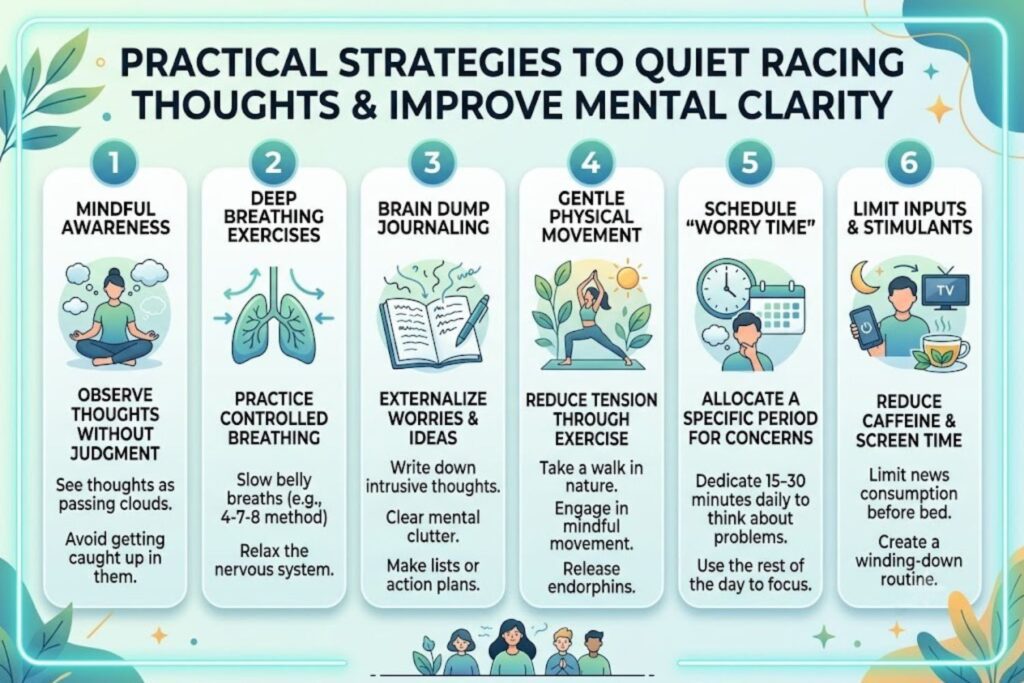
Have you ever replayed a conversation dozens of times, worried about a decision you haven’t made yet, or imagined every possible worst-case scenario before taking action? If so, you’re not alone. Learning how to stop overthinking isn’t about forcing your mind to be silent—it’s about changing how you respond to your thoughts.
Overthinking can affect your relationships, work, sleep, confidence, and overall well-being. While thinking things through is healthy, repeatedly analyzing the same situation without reaching a solution can leave you feeling mentally exhausted.
The good news is that overthinking is a habit, and like many habits, it can be changed. By understanding why your brain gets stuck in these thought loops and using practical strategies, you can reduce mental clutter, make decisions with more confidence, and enjoy greater peace of mind.
What Is Overthinking?
Quick Answer: Overthinking is the habit of dwelling on the same thoughts, worries, or decisions without making meaningful progress. Instead of solving problems, it often increases stress, anxiety, and self-doubt.
Everyone thinks carefully before making important decisions. The difference is that productive thinking moves you toward action, while overthinking keeps you stuck in an endless cycle of “what if” questions.
Thinking vs. Overthinking
| Healthy Thinking | Overthinking |
|---|---|
| Focuses on solutions | Focuses on problems |
| Leads to decisions | Delays decisions |
| Uses facts | Assumes worst-case scenarios |
| Has a clear end | Repeats endlessly |
| Encourages action | Creates paralysis |
A simple question can help you recognize the difference:
“Is this thought helping me move forward, or am I replaying the same concern without learning anything new?”
If the answer is the second option, you’re likely overthinking.
Why Do We Overthink?
Overthinking isn’t a personality flaw. It’s often your brain’s attempt to protect you from uncertainty or failure.
Fear of Making Mistakes
Many people believe there is one perfect decision. They keep gathering information, hoping they’ll eventually feel 100% certain.
In reality, most decisions involve some level of uncertainty.
Perfectionism
Perfectionists often believe mistakes define their worth. This pressure leads to excessive planning, constant editing, and difficulty completing tasks.
Anxiety
When you’re anxious, your brain naturally scans for possible threats. This survival response can make ordinary situations feel much more serious than they are.
Past Experiences
A previous disappointment, failure, or difficult relationship may train your mind to look for danger everywhere, even when none exists.
The Need for Control
Life is unpredictable. Overthinking creates the illusion of control, even though repeatedly analyzing a situation rarely changes the outcome.
Signs You’re Stuck in an Overthinking Loop
Recognizing the signs is the first step toward changing the pattern.
Mental Signs
- Replaying conversations repeatedly
- Constant “what if” thinking
- Difficulty concentrating
- Indecisiveness
- Second-guessing every choice
Emotional Signs
- Persistent worry
- Irritability
- Feeling mentally drained
- Self-doubt
- Fear of failure
Physical Signs
- Trouble falling asleep
- Muscle tension
- Fatigue
- Headaches
- Restlessness
These symptoms don’t necessarily indicate a mental health condition, but if they become persistent or interfere with daily life, it’s worth speaking with a qualified healthcare professional.
Is It Overthinking or Problem Solving?
Before trying to stop overthinking, ask yourself these questions:
- Have I already considered the available facts?
- Am I repeating the same thoughts?
- Can I take one useful action today?
- Am I looking for certainty that doesn’t exist?
- Would more thinking realistically change the outcome?
If most of your answers suggest you’re repeating thoughts rather than discovering new information, it’s time to shift from thinking to doing.
Expert Tip: Your brain often rewards certainty, but progress usually comes from taking small, imperfect actions—not from finding perfect answers.
15 Proven Ways to Stop Overthinking
1. Identify the Thought Pattern
Not all overthinking looks the same.
Common patterns include:
- Catastrophizing
- Assuming what others think
- Perfectionism
- Self-criticism
- Rumination about the past
Naming the pattern creates distance between you and the thought.
Instead of saying:
“I’ll definitely fail.”
Try:
“I’m noticing that I’m catastrophizing.”
This subtle shift reminds you that thoughts are not facts.
2. Challenge Worst-Case Scenarios
Our brains naturally pay more attention to potential threats than positive outcomes.
When you notice yourself imagining the worst, ask:
- What’s the evidence?
- What’s the most likely outcome?
- If the worst happened, how would I respond?
This exercise doesn’t ignore risks. It simply replaces fear-driven assumptions with balanced thinking.
Real-World Example
Imagine you’re waiting for an email after a job interview.
Overthinking says:
“They hated me.”
Balanced thinking says:
“They may still be interviewing candidates, or they’re simply busy.”
The second response is based on possibility rather than assumption.
3. Create a “Worry Window”
Trying to suppress anxious thoughts often makes them stronger.
Instead, schedule a dedicated 15-minute “worry window” each day.
When anxious thoughts appear outside that time:
- Write them down.
- Remind yourself you’ll revisit them later.
- Return to the task you’re doing.
Many people discover that by the time the worry window arrives, several concerns no longer feel important.
4. Take One Small Action
Overthinking thrives on inaction.
Action interrupts the cycle.
Instead of asking:
“What’s the perfect solution?”
Ask:
“What’s the smallest helpful step I can take in the next five minutes?”
Examples include:
- Sending the email.
- Making the phone call.
- Writing the first paragraph.
- Scheduling the appointment.
- Organizing one small area.
Momentum often reduces anxiety more effectively than continued analysis.
5. Practice Mindfulness Without Trying to Empty Your Mind
Many people believe mindfulness means stopping all thoughts.
It doesn’t.
Mindfulness teaches you to observe thoughts without automatically believing or reacting to them.
A simple one-minute exercise:
- Notice five things you can see.
- Notice four things you can touch.
- Notice three sounds.
- Notice two scents.
- Notice one thing you can taste.
This grounding technique gently shifts your attention away from repetitive thinking and back to the present moment.
6. Limit Information Overload
One overlooked cause of overthinking is having too much information.
Whether you’re choosing a laptop, planning a vacation, or deciding on a career move, endless research can make decisions harder rather than easier.
Try setting limits:
- Read three trusted sources.
- Compare your top two options.
- Decide by a specific deadline.
Remember, more information doesn’t always lead to better decisions.
7. Stop Seeking Constant Reassurance
Asking others for advice can be helpful.
Repeatedly asking the same question in search of certainty often reinforces overthinking.
Instead of seeking another opinion, ask yourself:
- “What would I advise a close friend in this situation?”
- “Do I already have enough information to decide?”
Learning to trust your judgment builds confidence over time.
8. Improve Your Sleep Routine
Poor sleep and overthinking often reinforce each other. Racing thoughts make it difficult to fall asleep, while lack of quality sleep makes it harder to regulate emotions the next day.
To improve your sleep:
- Keep a consistent bedtime and wake-up time.
- Avoid screens for at least 30–60 minutes before bed.
- Write tomorrow’s to-do list to clear your mind.
- Reduce caffeine later in the day.
- Practice a calming bedtime routine, such as reading or gentle stretching.
If nighttime thoughts keep returning, keep a notebook by your bed. Writing them down signals to your brain that you don’t need to keep rehearsing them.
9. Reduce Social Media Comparison
Social media often shows carefully edited highlights of other people’s lives. Comparing your everyday reality to someone else’s best moments can fuel self-doubt and endless analysis.
Try these habits:
- Limit scrolling time.
- Unfollow accounts that consistently make you feel inadequate.
- Follow creators who educate or inspire rather than encourage comparison.
- Take regular digital breaks.
Less comparison creates more mental space for your own goals.
10. Journal With Purpose
Journaling isn’t just about recording your thoughts. It helps organize them.
Try answering these prompts:
- What am I worried about?
- Is this within my control?
- What’s one action I can take today?
- What evidence supports this fear?
- What would I tell a friend in the same situation?
This transforms your journal from a place of rumination into a tool for problem-solving.
11. Move Your Body
Physical activity supports mental well-being by helping reduce stress and improving mood.
You don’t need an intense workout.
Consider:
- A 20-minute walk
- Stretching
- Yoga
- Cycling
- Dancing
- Strength training
Movement also shifts your attention away from repetitive thoughts and into the present moment.
12. Practice Self-Compassion
Many people who overthink are far kinder to others than they are to themselves.
Notice your inner dialogue.
Replace:
“I always mess things up.”
With:
“I made a mistake, and I can learn from it.”
Self-compassion doesn’t lower your standards—it helps you recover more quickly and make better decisions.
13. Let Go of Perfectionism
Perfectionism often disguises itself as responsibility or ambition.
In reality, it can delay progress.
Ask yourself:
- Does this task truly need to be perfect?
- Will anyone notice this small detail?
- Is “good enough” enough?
Done is often better than perfect.
14. Focus on What You Can Control
One of the fastest ways to reduce overthinking is separating concerns into two categories.
| Things You Can Control | Things You Can’t Control |
|---|---|
| Your actions | Other people’s opinions |
| Your effort | The past |
| Your habits | Unexpected events |
| Your responses | Every possible outcome |
Spend more energy where you have influence.
15. Know When to Seek Professional Help
Sometimes overthinking becomes persistent and significantly affects daily life.
Consider speaking with a licensed mental health professional if you experience:
- Constant anxiety
- Panic attacks
- Difficulty functioning at work or school
- Ongoing sleep problems
- Persistent feelings of hopelessness
- Obsessive or intrusive thoughts that interfere with daily life
Therapies such as Cognitive Behavioral Therapy (CBT) and mindfulness-based approaches have been shown to help many people develop healthier thinking patterns. A qualified professional can recommend the most appropriate treatment based on your individual needs.
Common Mistakes That Keep People Overthinking
Avoid these common traps:
- Waiting until you feel completely certain before acting.
- Researching endlessly instead of making a decision.
- Replaying conversations that can’t be changed.
- Assuming your thoughts are facts.
- Avoiding discomfort rather than addressing it.
- Trying to predict every possible outcome.
- Expecting immediate results instead of gradual progress.
Recognizing these habits is often the first step toward changing them.
A Simple 7-Day Plan to Reduce Overthinking
Day 1
Notice recurring thought patterns and write them down.
Day 2
Challenge one negative assumption with evidence.
Day 3
Practice a five-minute mindfulness exercise.
Day 4
Set a 15-minute worry window.
Day 5
Complete one task you’ve been delaying.
Day 6
Reduce social media use by 30 minutes.
Day 7
Reflect on what improved, what remained challenging, and which habits you want to continue.
Small, consistent changes often produce more lasting results than dramatic changes that are difficult to maintain.
Final Thoughts
Learning how to stop overthinking doesn’t mean you’ll never worry again. It means recognizing when your thoughts are no longer helping and choosing a healthier response.
The goal isn’t to eliminate uncertainty—it’s to build confidence in your ability to handle it.
By practicing self-awareness, challenging unhelpful thought patterns, taking meaningful action, and caring for your mental well-being, you can gradually quiet the mental noise and create more room for clarity, confidence, and peace.
If you’re looking for more practical guidance on mindfulness, emotional wellness, and personal growth, explore the resources available on Daily Dose Of Dee. Every small step you take today can help build a calmer, more resilient tomorrow.
Frequently Asked Questions
1. What is the fastest way to stop overthinking?
Ground yourself in the present moment, challenge worst-case assumptions, and take one small action instead of continuing to analyze the situation.
2. Is overthinking a mental illness?
No. Overthinking itself is not a mental illness, but it can occur alongside anxiety disorders, depression, OCD, or chronic stress.
3. Why do I overthink at night?
Quiet environments, fewer distractions, and accumulated stress during the day can make racing thoughts more noticeable at bedtime.
4. Can mindfulness stop overthinking?
Mindfulness doesn’t eliminate thoughts. It helps you notice them without automatically reacting to them.
5. Is overthinking caused by anxiety?
Anxiety can contribute to overthinking, but perfectionism, uncertainty, past experiences, and stress may also play important roles.
6. How long does it take to stop overthinking?
There’s no fixed timeline. Consistent practice of healthy coping strategies often leads to gradual improvement over weeks and months.
7. Does exercise help reduce overthinking?
Yes. Regular physical activity supports stress management and can improve mood and mental clarity.
8. Should I seek therapy for overthinking?
If overthinking consistently interferes with your work, relationships, sleep, or daily functioning, speaking with a licensed mental health professional is a good next step.