
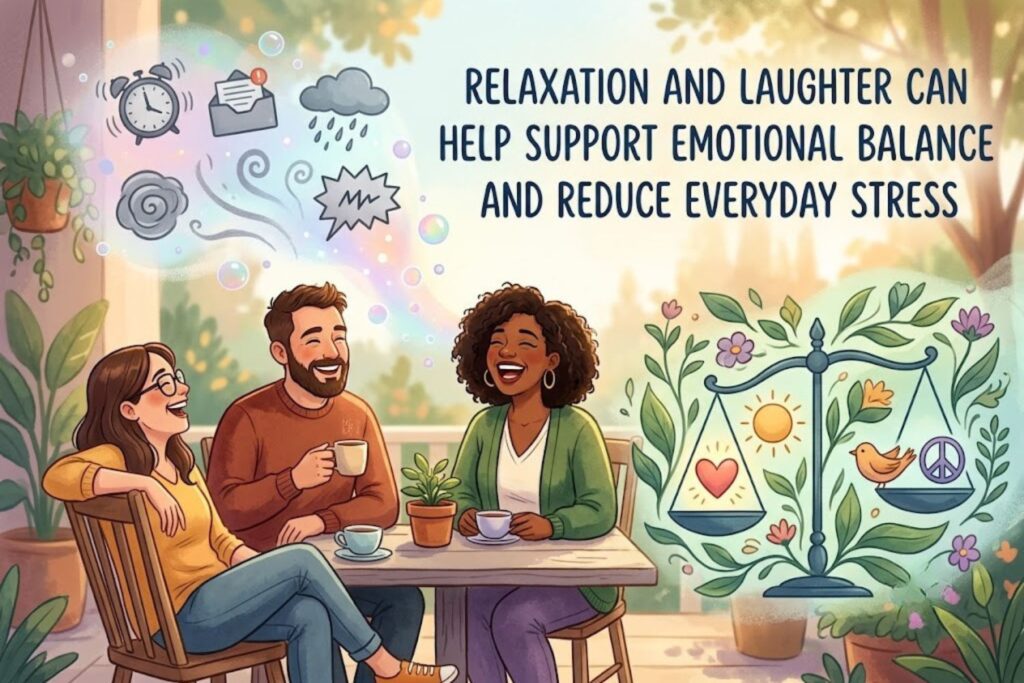
Stress has become a normal part of modern life. Deadlines, digital overload, workplace pressure, financial responsibilities, and personal challenges can keep the mind in a constant state of alertness.
Many people search for ways to reduce stress, but they often overlook two simple tools that are naturally available: relaxation and laughter.
Relaxing and laughing help reduce stress by calming the body’s stress response, improving emotional balance, reducing physical tension, and helping the brain shift from a state of pressure to a calmer state. While they do not remove every stressful situation, they can help people respond to challenges with greater clarity and resilience.
Understanding how these responses work can help you use them intentionally in everyday life.
Understanding How Stress Affects Your Mind and Body
Stress is the body’s natural response to situations that feel challenging, demanding, or threatening. In short bursts, stress can be useful because it increases focus and energy.
For example:
- A developer preparing for a major software release may become more alert.
- A professional giving an important presentation may experience increased concentration.
- An athlete preparing for competition may feel energized.
The problem begins when stress becomes constant.
What Happens During the Stress Response?
When you experience stress, your body activates its survival system, often called the fight-or-flight response.
Your brain signals the body to prepare for action. This can lead to:
- Faster heartbeat
- Increased muscle tension
- More rapid breathing
- Heightened alertness
- Difficulty relaxing
This response is helpful when dealing with immediate challenges. However, when the body remains in this activated state for too long, it can contribute to emotional exhaustion and mental fatigue.
Why Chronic Stress Can Become Harmful
Long-term stress can affect:
- Mood
- Sleep quality
- Concentration
- Motivation
- Overall emotional well-being
Many professionals experience this through burnout.
For example, a technology worker may spend long hours solving problems, attending meetings, and managing constant notifications. Over time, the brain may struggle to switch from “work mode” into a relaxed state.
This is where intentional relaxation and moments of laughter can become valuable.
How Relaxing Helps Reduce Stress
Relaxation is not simply “doing nothing.”
Effective relaxation is an active process that tells your body and brain that it is safe to slow down.
Relaxation Activates the Body’s Calm Response
When you relax, your body can move away from stress activation and toward a calmer state.
This may help:
- Slow breathing patterns
- Reduce muscle tension
- Improve emotional control
- Create mental space for problem-solving
A relaxed mind is often better equipped to handle challenges because it is not constantly reacting from a state of pressure.
How Relaxation Techniques Calm the Brain
Different relaxation methods work in different ways.
Deep Breathing
Slow breathing can help create a sense of calm by encouraging the body to reduce physical stress signals.
A simple technique:
- Breathe in slowly through your nose.
- Hold briefly.
- Exhale slowly.
- Repeat several times.
This can be useful during stressful moments such as:
- Before a difficult conversation
- During a busy workday
- After receiving overwhelming information
Progressive Muscle Relaxation
Stress often appears physically through:
- Tight shoulders
- Jaw tension
- Stiff posture
- Headaches
Progressive muscle relaxation involves intentionally tightening and releasing different muscle groups.
This helps people notice where they hold tension and consciously release it.
Mindfulness and Meditation
Mindfulness involves paying attention to the present moment without immediately judging thoughts or emotions.
Instead of thinking:
“I cannot handle this.”
A person may learn to observe:
“I am experiencing stress right now, but I can respond calmly.”
This small shift can improve emotional regulation.
How Laughing Helps Reduce Stress
Laughter is more than a reaction to something funny.
It is a physical and emotional response that can influence how we experience stressful situations.
The Connection Between Laughter and Brain Chemistry
When people laugh, the brain experiences positive emotional activity.
Laughter may help:
- Improve mood
- Reduce feelings of tension
- Encourage positive emotions
- Create a sense of connection with others
A genuine laugh can interrupt a cycle of negative thinking and provide a brief emotional reset.
Why Humor Helps During Difficult Moments
Humor can change how people view stressful situations.
This does not mean ignoring serious problems.
Instead, healthy humor creates psychological distance.
For example:
A software engineer struggling with a difficult bug may become frustrated after hours of troubleshooting.
Taking a short break, sharing a funny moment with a colleague, or finding something lighthearted can reduce emotional pressure.
When returning to the problem, the person may feel more refreshed and capable of thinking creatively.
Why Relaxation and Laughter Work Better Together
Relaxation and laughter affect stress in different but complementary ways.
Relaxation primarily helps calm the body.
Laughter helps shift emotional perspective.
Together, they can support:
| Relaxation | Laughter |
|---|---|
| Reduces physical tension | Improves mood |
| Helps calm racing thoughts | Creates emotional relief |
| Supports focus | Encourages connection |
| Helps restore energy | Makes challenges feel more manageable |
Using both creates a balanced approach to stress management.
Relaxation vs Avoidance: Understanding the Difference
A common misunderstanding is that relaxing means avoiding responsibilities.
That is not true.
Healthy Relaxation
Healthy relaxation:
✓ Restores mental energy
✓ Improves concentration
✓ Helps regulate emotions
✓ Allows better decision-making
Examples:
- Taking a short walk
- Practicing breathing exercises
- Listening to calming music
- Sharing laughter with friends
Stress Avoidance
Avoidance looks different.
Examples:
- Ignoring important problems
- Refusing to address responsibilities
- Constantly distracting yourself
Relaxation helps you return stronger.
Avoidance keeps problems unresolved.
Practical Ways to Use Relaxation and Laughter Every Day
Stress management does not always require major lifestyle changes.
Small actions repeated consistently can make a difference.
The 5-Minute Stress Reset
Try this simple process:
Step 1: Pause
Stop what you are doing for a moment.
Create distance between yourself and the stressful situation.
Step 2: Breathe Slowly
Take several slow breaths.
Focus on making your breathing steady.
Step 3: Release Physical Tension
Relax:
- Your shoulders
- Your jaw
- Your hands
- Your facial muscles
Step 4: Add a Moment of Humor
Try:
- Watching something funny
- Sharing a joke with someone
- Remembering a positive experience
Step 5: Return With More Clarity
After calming your body and mind, approach the situation again.
How Tech Professionals Can Use Relaxation and Humor to Manage Stress
Technology careers often involve unique stressors:
- Long screen hours
- Complex problem-solving
- Tight deadlines
- Continuous learning
- Remote work isolation
For professionals in technology, small recovery moments can prevent mental overload.
Examples:
During Debugging Frustration
Instead of spending hours becoming increasingly frustrated:
- Step away briefly
- Stretch
- Talk with a teammate
- Return with a fresh perspective
During High-Pressure Releases
Before a major launch:
- Use breathing techniques
- Avoid constant screen exposure
- Create moments of team connection
A relaxed team often communicates more effectively.
Common Mistakes When Trying to Reduce Stress
Mistake 1: Waiting Until Stress Becomes Extreme
Many people only practice stress management after burnout appears.
Better approach:
Create small daily habits before stress becomes overwhelming.
Mistake 2: Thinking Relaxation Is Unproductive
Rest is often viewed as lost time.
However, recovery supports:
- Creativity
- Focus
- Decision-making
- Emotional resilience
Mistake 3: Using Humor to Avoid Emotions
Humor can help, but it should not be used to dismiss serious feelings.
Healthy humor says:
“This situation is difficult, but I can handle it.”
Avoidance says:
“This problem does not matter.”
Quick Answer: How Do Relaxing and Laughing Reduce Stress?
Relaxing reduces stress by helping the body shift from a stress response into a calmer state. Laughing helps by improving mood, reducing emotional tension, and creating positive mental shifts. Together, they support better emotional regulation and resilience.
FAQ SECTION
1. How does relaxing help reduce stress?
Relaxing helps reduce stress by calming the body’s stress response. Relaxation techniques such as deep breathing, meditation, and muscle relaxation can reduce physical tension, slow racing thoughts, and improve emotional balance.
2. How does laughing help reduce stress?
Laughing can help reduce stress by improving mood, encouraging positive emotions, relaxing muscles, and creating a mental break from stressful thoughts. It can also strengthen social connections, which support emotional well-being.
3. Why does laughter make you feel better when you are stressed?
Laughter can create a temporary shift away from stressful thinking. It helps the brain focus on positive emotions and can make difficult situations feel more manageable.
4. Can laughter actually lower stress hormones?
Laughter may influence the body’s stress response and support relaxation. While laughter is not a cure for stress, it can be a helpful tool for improving mood and reducing feelings of tension.
5. What relaxation techniques reduce stress quickly?
Common relaxation techniques include:
- Deep breathing exercises
- Meditation
- Progressive muscle relaxation
- Stretching
- Listening to calming music
- Taking a short walk
The best technique depends on the person’s needs and situation.
6. Is laughing better than relaxation for stress relief?
Neither is necessarily better. Relaxation mainly helps calm physical stress responses, while laughter helps improve mood and emotional perspective. Using both together can provide stronger stress-management support.
7. How can busy professionals relax during a stressful workday?
Busy professionals can try short stress-management techniques such as:
- Taking a few slow breaths
- Stepping away from screens briefly
- Stretching
- Talking with coworkers
- Finding moments of humor
Even small breaks can help reset attention and energy.
8. Does watching something funny reduce stress?
Watching something funny may help improve mood and provide temporary emotional relief. Humor can create a positive mental shift during stressful moments.
9. Can relaxation prevent burnout?
Relaxation alone cannot prevent all forms of burnout, but regular recovery habits can support emotional resilience, improve focus, and help people manage ongoing stress more effectively.
10. How often should you practice relaxation techniques?
Consistency matters more than duration. Short daily relaxation practices may be more effective than occasional long sessions because they help build a regular habit of stress management.